Essay
Nakshatra Lord and Sign Lord
Venus may own the sign while Mars owns the mansion. Two hosts, two jobs — and a common source of mixed signals in interpretation.
nakshatra · lordship · foundations
18 Sept 2026 · 4 min read
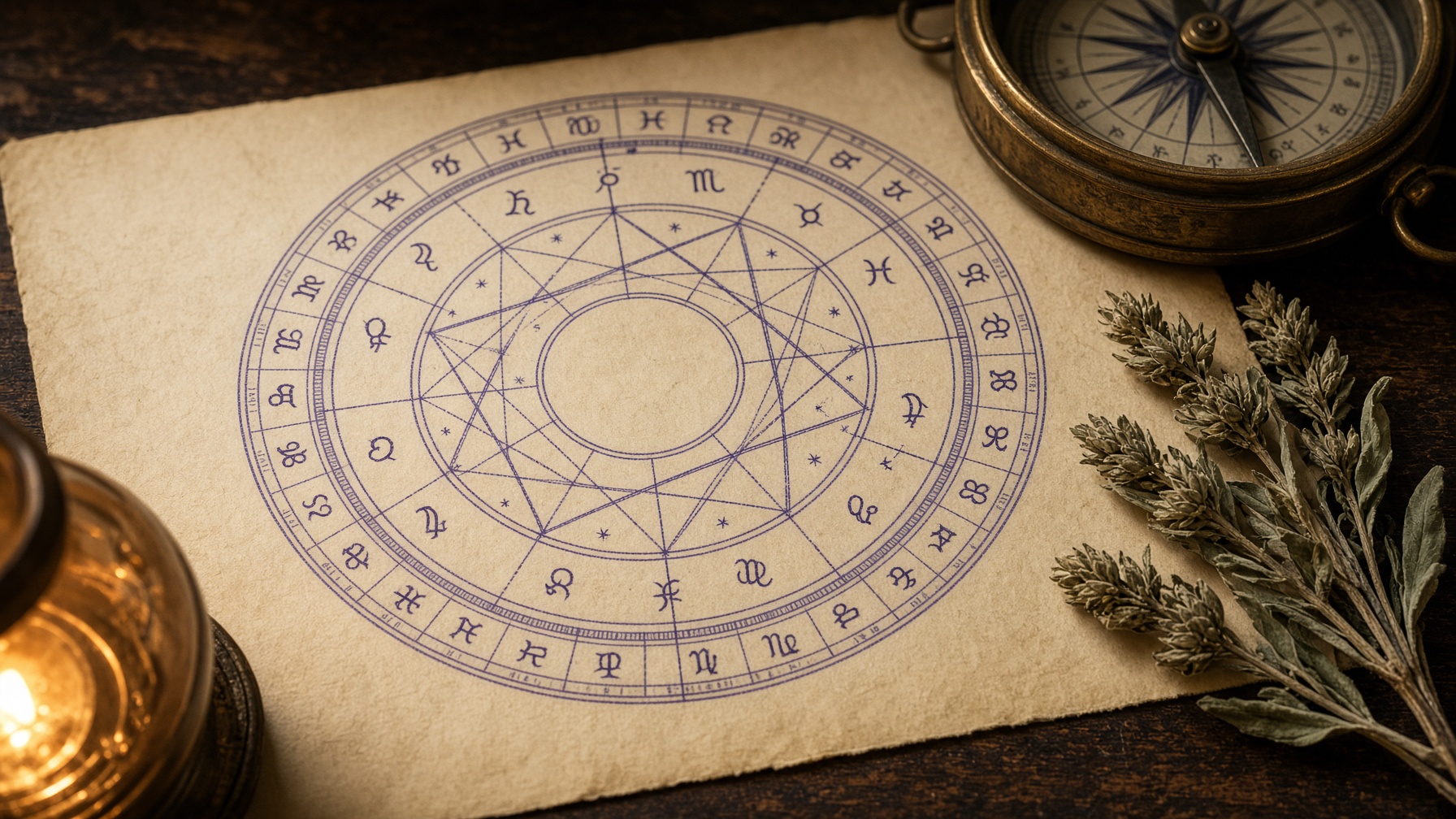
Take Venus in Bharani. The sign is Aries, so Mars is the rashi lord — the host of the thirty-degree span. Bharani’s nakshatra lord is Venus herself. The planet is a guest in Mars’s sign and, at the mansion level, in her own territory. Those two facts can be true in the same degree. They do not cancel. They stack.
Readers who treat “planet in Aries” as the whole placement will hear only Mars. Readers who treat “Bharani Moon” as a personality type will hear only the mansion’s folklore. The technical task is smaller and harder: say who owns the sign, who owns the nakshatra, and what each owner is doing in the rest of the chart.
Two kinds of ownership
The sign lord (rashi disponent) is the planet that owns the 30° sign. It is the usual dispositor in dignity work, in house rulership, and in the chain that asks “who is this planet staying with?” The nakshatra lord (tara or nakshatra disponent, in common teaching) owns the 13°20′ slice. In dasha theory it is especially loud, because Vimshottari is a sequence of nakshatra lords. A planet sitting in a Saturn-ruled mansion is, at that layer, in Saturn’s term even if the sign belongs to Jupiter.
Some schools read the nakshatra lord as a second dispositor for results, especially in timing. Others keep it mainly for dasha and for lunar work. CapSage does not appoint a winner. We will say both lords are facts on the page, and that mixing them without naming the layer is how a chart acquires two captains and no crew.
Nodes as mansion lords
Rahu and Ketu own no rashis in the usual seven-graha scheme. They do own nakshatras. That is one of the places the nodes enter ordinary planetary reading without anyone having to invent a sign for them. A Jupiter in Ardra has Jupiter’s own nature, Gemini’s Mercury as sign lord, and Rahu as mansion lord. Three facts. If Jupiter’s dasha is running, you are hearing Jupiter’s natal job; if the question is “who hosts this slice?”, Rahu is on the list. Collapsing those three into “Jupiter is like Rahu” is the personality-machine again.
The same caution applies to Ketu-ruled Magha, Mula, and Ashwini. Ketu as mansion lord is not moksha sprinkled on whoever sits there. It is a traditional ruler of a 13°20′ span, to be read with Ketu’s natal condition and with the occupying planet’s job.
When they agree, and when they argue
Agreement is straightforward: Moon in Rohini is in Taurus (Venus as sign lord) and in a Moon-ruled mansion. The lunar theme is being hosted by Venus and, at the mansion layer, by the Moon itself. If Venus is well placed for the lagna and the Moon is not under heavy strain, the two hosts are at least not at war.
Argument is equally common. Mars in Anuradha sits in Scorpio — its own sign — inside a Saturn-ruled nakshatra. Own-sign Mars is a dignity fact. Saturn as mansion lord is a second fact. Traditional teaching often hears discipline, delay, or a colder edge on that Mars. Whether that edge shows as endurance or as frustration depends on Saturn’s own condition, on house lordship, and on which dasha is running. The disagreement is information. It is not a glitch in the software.
Lordship is still a job, not a mood
How to Read a Planet in Context already insists that a graha be read as lord of houses, occupant of a house, and member of relationships. Nakshatra lordship adds another relationship: this planet is occupying that planet’s mansion. Occupying is not the same as becoming. A Sun in a Rahu-ruled nakshatra does not turn into Rahu. It occupies a slice whose traditional ruler is Rahu, which may colour appetite, visibility, or irregularity around solar themes — if the rest of the chart agrees.
Practical sequence
Name the sign lord. Name the nakshatra lord. Note whether they are friends, equals, or traditional enemies. Then look at both planets in the natal chart: dignity, house, aspects. If only one of them is running in dasha, that layer may be louder for a while. If the birth time cannot support the degree, do not pretend you know the mansion. Sign-level work may still be honest. Nakshatra-level work may not.
The useful question is not “which lord wins?” It is “what is each lord responsible for, and which layer am I actually reading right now?”
Continue
Continue this idea

Essay
What a Nakshatra Adds to a Chart
Each lunar mansion spans 13°20′. That finer grain changes planetary flavour, dasha seed, and matching work — without replacing sign, house, or lordship.
nakshatra · moon · foundations
5 min read
Essay
How to Read a Planet in Context
Why one placement is never the whole chart
interpretation · method · foundations
11 min read
Situation
Related situation
Situation
Why Do I Keep Attracting the Same Kind of Relationship?
A new face. The old argument. The seventh house as weather you walk into wearing last year's coat.
relationships · seventh house · venus
2 min read
Response
Related solution
Solution
When Your Chart Says Wait but Life Requires Action
Astrology may inform a decision. It does not get to replace one. The deadline in the world still counts.
decision · timing · agency
2 min read
Also
From the Method
18 Sept 2026 · 4 min · CapSage Astro